
SEO Strategies to Abandon
 Timothy Carter
Volatility is the new normal for the SEO services industry. Steady algo rollouts and upcoming technological and cultural developments like wearable devices will dictate the course of events in 202X and beyond. If you’re going to survive subsequent Google updates in the radically changing landscape of link building and SEO, you’ll need to do some tweaking to your existing SEO strategies to work in an AI search world.
Outdated SEO Strategy Why It No Longer Works Modern SEO Alternative Keyword stuffing Search engines now understand semantic intent and context. Build topical relevance with natural language, entities, and complete answers. Publishing thin blog posts frequently Low-value content is easier to ignore, especially in an AI-saturated web. Publish fewer, deeper, more authoritative resources. Chasing backlinks at any cost Low-quality and irrelevant links are discounted or may create risk. Use digital PR, expert commentary, brand mentions, and relevant authority links. Exact-match anchor text obsession Over-optimized anchor patterns look manipulative. Use natural anchor diversity and contextually relevant links. Writing only for Google rankings Search behavior now spans Google, AI tools, YouTube, Reddit, TikTok, and more. Optimize for multi-platform visibility and audience discovery. Using rankings as the main KPI Rankings do not always translate into clicks, leads, or revenue. Measure qualified traffic, conversions, branded search, pipeline, and revenue impact. Mass programmatic SEO pages Template-heavy pages often create index bloat and thin content. Create curated, useful content hubs with clear search intent and editorial oversight. Generic AI-generated content Undifferentiated content lacks experience, originality, and trust. Add firsthand expertise, original data, examples, case studies, and strong editing. Ignoring UX and site performance Poor usability reduces engagement, trust, and conversion rates. Improve page speed, navigation, readability, mobile experience, and conversion paths. Optimizing only for clicks AI answers and zero-click searches reduce traditional organic CTR. Optimize for visibility, citations, brand recall, and assisted conversions. Publishing isolated pages Standalone content often lacks contextual authority. Build topic clusters with strong internal linking and clear content architecture. Building anonymous websites Trust, brand recognition, and entity authority increasingly matter. Invest in brand building, author credibility, reviews, mentions, and authority signals.
Notably, there are several popular SEO strategies you’ll have to part with as soon as possible:
Abandon the Obsession With Ranking #1
For years, SEO strategies revolved around one goal: ranking in the top position on Google. While rankings still matter, the search landscape has changed dramatically. Today, even the number one organic result may receive fewer clicks than a lower-ranking result did just a few years ago.
The rise of AI Overviews, featured snippets, knowledge panels, video carousels, Reddit threads, and other SERP features has fragmented user attention. In many cases, users now receive answers directly inside search results without ever clicking through to a website.
This shift means businesses need to stop viewing SEO purely through the lens of rankings. Visibility, brand recognition, and authority have become equally important metrics. A website that consistently appears in AI-generated answers, industry discussions, and multiple search surfaces may generate more long-term value than a page that simply ranks first for a keyword.
Modern SEO is no longer about winning a single blue link. It is about building search presence across the entire digital ecosystem.
Abandon Keyword-Based Optimization
Most search engine optimizers already have a shaky, love-hate relationship with keywords; they love it when they can dominate the rank for a given keyword phrase, but loathe the futility of chasing after those high-competition phrases.
Still, up until the last couple of years, most optimizers believed that keywords would always be one of the most important components of an SEO strategy—after all, you can’t perform a search without keywords, and you can’t rank unless you’re ranking for a specifically entered phrase, right? "Semantic search,” which was first introduced to the search world via the Hummingbird Update of 2013 is an algorithmic process that supersedes the traditional keyword-based approach. Subsequent updates, including deeper implementation of machine learning and artificial intelligence through RankBrain has further degraded the focus on keywords as a primary SEO strategy. While an older search query would simply be disassembled into its keyword and keyword phrase components in order to find those components as they read verbatim on the web, semantic search offers a more complex and more precise methodology. User queries are analyzed in terms of their intent, rather than their content, and Google scours the web interpreting the function of different websites to find the most appropriate results, rather than the most mathematically correct ones. Since the shift toward semantic search is only going to grow in prevalence and sophistication, that means only one thing for traditional keyword-based optimization strategies: certain death. The process of writing title tags and meta tags with carefully selected keywords and stuffing your articles full of just the right number of keyword phrases you want to optimize for is already dying, and will probably be long gone by the end of the year. Instead of focusing on keyword research and keyword-based optimization strategies, shift your focus to topics. Use research to find out what topics people are talking about, and what topics your audience might be interested in reading. Write articles about those topics, and be as detailed as possible so Google robots can learn the purpose of your article and fetch it for appropriate inbound queries. Your goal here is to present your company—and your content—as accurately and as detailed as possible, without getting lost in a strategy that’s too focused on keyword inclusion.
Abandon Writing “SEO Content”
One of the biggest mistakes businesses still make is creating content primarily for algorithms instead of users. For years, SEO content followed a predictable formula: identify a keyword, repeat it enough times, and publish a long article optimized for search crawlers.
That approach is rapidly losing effectiveness.
Search engines and AI systems have become significantly better at evaluating content quality, originality, expertise, and usefulness. Generic content written solely to target keywords often lacks depth, insight, and differentiation. As AI-generated content floods the internet, low-value articles are becoming easier for algorithms to ignore.
Businesses should stop asking, “How do we rank for this keyword?” and start asking, “How do we become the best source of information on this topic?”
The most effective modern SEO content tends to include firsthand experience, expert commentary, proprietary data, real examples, strong opinions, and genuinely useful insights. Content that teaches something unique is far more likely to earn backlinks, citations, shares, and long-term rankings.
In the AI era, citation-worthy content matters more than keyword-focused content.
Abandon Keyword Density Obsession
There was a time when SEO professionals carefully calculated keyword density percentages and forced exact-match phrases into headings, paragraphs, image alt text, and anchor links. Some websites repeated keywords so aggressively that the content became unreadable.
That strategy is outdated.
Modern search engines understand semantic relationships, user intent, entities, and contextual meaning. Google no longer needs exact keyword repetition to understand what a page is about. In fact, excessive optimization can now hurt readability and potentially trigger spam signals.
Today, strong SEO content focuses on topical completeness rather than keyword stuffing. Instead of forcing the same phrase repeatedly, successful pages naturally cover related concepts, supporting terms, questions, and entities associated with the topic.
This shift is especially important as AI-powered search systems become more advanced.
Platforms like ChatGPT and Perplexity synthesize meaning and context rather than simply matching keywords.
It also represents a shift away from direct strategies of using SEOToolLab or SurferSEO to optimize individual pages based on keyword density and specific disambiguation phrases. While this can still help, it's no longer the silver bullet it once was.
Businesses that continue over-optimizing for exact-match phrases risk creating robotic content that performs poorly with both users and algorithms.
Abandon the “Publish More Content” Mentality
For years, many SEO strategies relied heavily on content volume. Businesses believed that publishing hundreds or thousands of blog posts would automatically increase rankings and traffic.
Quantity alone no longer creates authority.
Search engines increasingly reward topical depth, expertise, and quality over sheer publishing frequency. A smaller website with highly authoritative content can now outperform massive content libraries filled with thin or repetitive articles.
Instead of focusing on content volume, modern SEO strategies should focus on topical authority. This means creating comprehensive coverage around core subject areas through interconnected topic clusters, strong internal linking, and detailed educational resources.
Publishing more content only works when the content meaningfully expands expertise and solves user problems. Otherwise, businesses risk creating content bloat, index inefficiencies, and weak pages that dilute overall site quality.
Take, for instance, the following, very popular and well-known SEO blog. The company massively scaled-up their on-site content over the last couple of years, only to see it tank in an update, likely due to unnatural content velocity compared to historical norms:
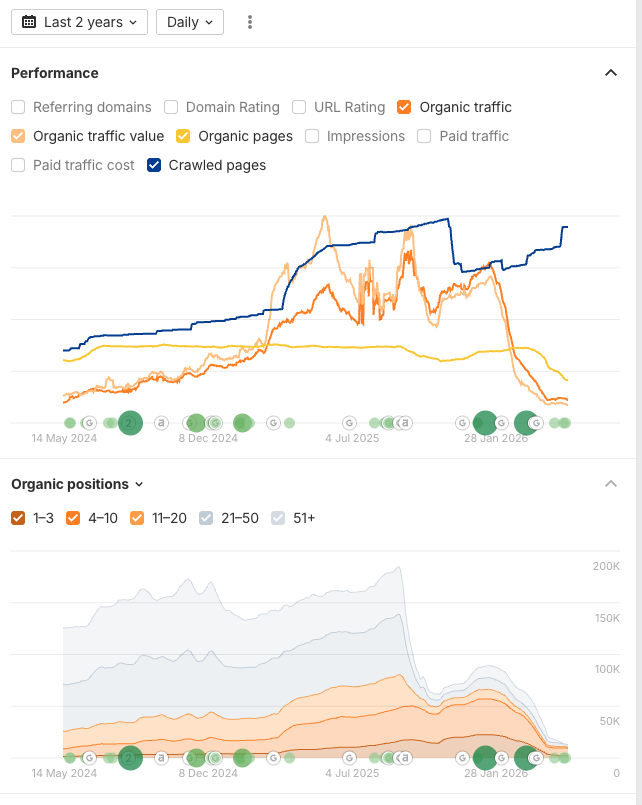
This popular SEO blog is the perfect case study of content velocity gone awry. You can see the large content scale-up and subsequent cliff drop.
The future of SEO belongs to businesses that create fewer, better resources rather than endless low-value content.
Abandon the Idea That SEO Is Only About Google
Search behavior has evolved far beyond traditional Google searches. Consumers now discover information through YouTube, TikTok, Reddit, LinkedIn, ChatGPT, Perplexity, Amazon, and other search-driven platforms.
This means businesses can no longer afford to think about SEO solely through the lens of Google rankings.
Younger demographics increasingly use TikTok and YouTube as primary search engines for tutorials, product recommendations, and reviews. Professionals search LinkedIn and podcasts for expertise. AI platforms synthesize answers from across the web. Reddit discussions often dominate transactional and informational search queries.
Modern SEO has become a broader digital visibility strategy.
Brands that diversify their search presence across multiple platforms often build stronger authority and greater resilience against algorithm changes. Businesses relying entirely on Google organic traffic may find themselves increasingly vulnerable as search behavior continues to fragment.
SEO and GEO are no longer just about ranking web pages. It is about being discoverable wherever people search for answers.
This is admittedly MUCH harder to do, but there are some overlapping strategies in your veritable optimization Venn Diagram that can help you not feel too overwhelmed.
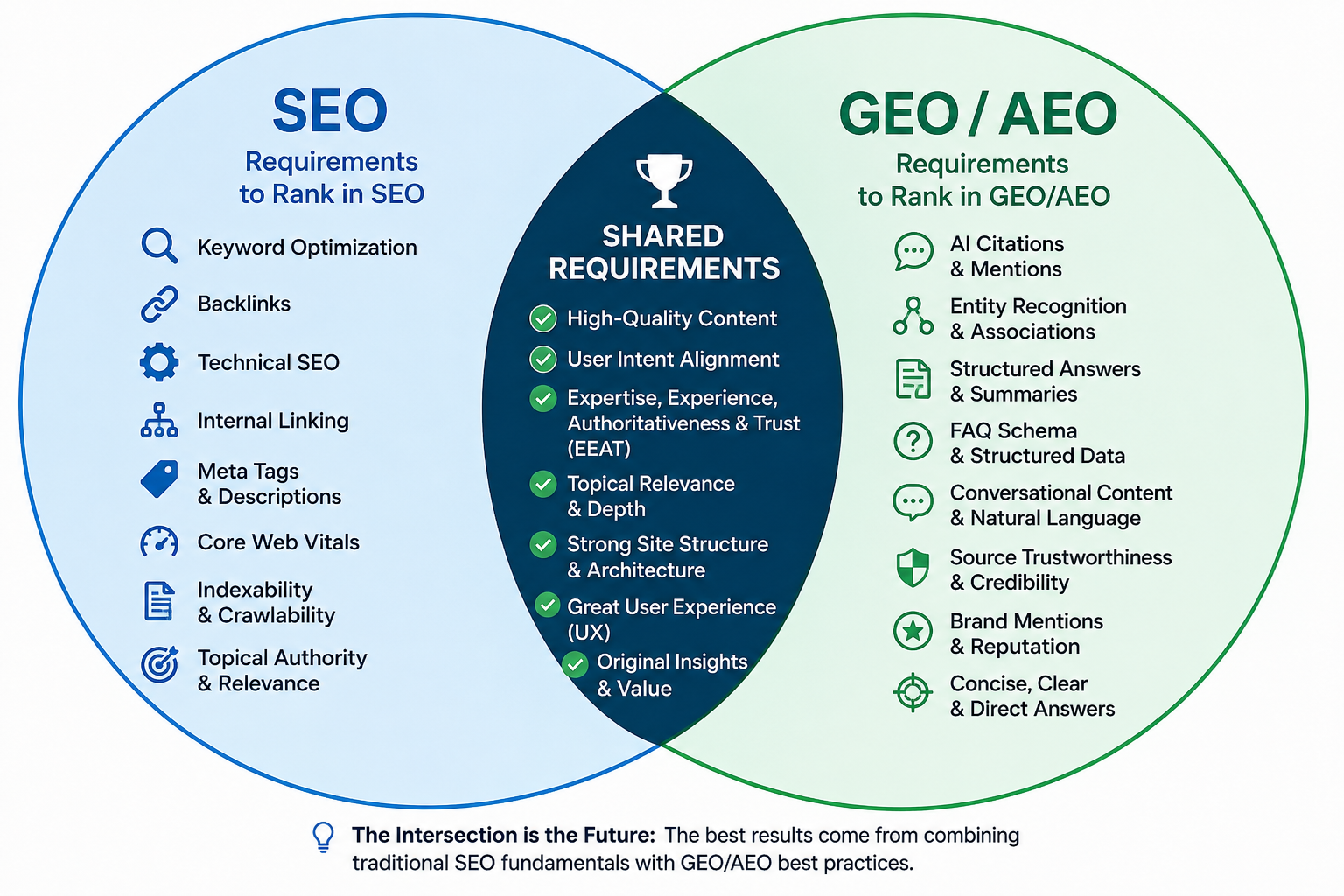
A Venn Diagram showing the overlap of SEO vs. GEO in modern search.
Abandon Vanity Traffic Metrics
Traffic growth used to be one of the primary ways SEO success was measured. More visitors typically meant more success. Today, that assumption is becoming increasingly flawed.
Not all traffic has business value.
Many websites attract large volumes of low-intent informational traffic that generates little revenue, few conversions, and minimal brand loyalty. At the same time, AI-generated answers and zero-click searches are reducing overall click-through rates across many industries.
As a result, businesses need to focus less on raw traffic numbers and more on traffic quality.
High-intent visitors who convert into leads, customers, subscribers, or repeat users are significantly more valuable than thousands of casual visitors with no buying intent. Modern SEO strategies should prioritize conversion optimization, branded search growth, audience retention, and revenue attribution rather than simply maximizing pageviews.
The companies winning with SEO today are often not the ones generating the most traffic. They are the ones generating the most profitable traffic.
Abandon Scaled Programmatic SEO Without Oversight
Programmatic SEO has exploded in popularity over the past several years, especially with the rise of AI-generated content.
Many businesses now attempt to create thousands of pages at scale using templates, automation, and large language models.
While programmatic SEO can still work in certain scenarios, uncontrolled scaling has become increasingly risky (as we have witnessed above).
Search engines are getting better at identifying thin, repetitive, low-value pages created primarily for rankings rather than users.
Mass-produced content often creates index bloat, poor engagement signals, crawl inefficiencies, and weakened site authority.
The problem is not necessarily automation itself. The problem is publishing pages that provide little unique value.
Successful modern programmatic SEO requires strong editorial oversight, high-quality data, differentiated information, and a clear user purpose. Businesses that blindly generate thousands of near-duplicate pages may see diminishing returns or even long-term ranking declines.
The future belongs to curated, experience-driven content ecosystems — not mass AI content factories.
Abandon General or Overview Content
Speaking of content, moving into 2015, you’ll want to abandon any tenets of your content strategy that focus on providing general information on broad topics, or overviews on subjects that have existed for years. Instead, you’ll want to focus on niche topics and highly specific topics that people will want to read about, particularly if you are hiring a blog writing service. There are several reasons for this. The first reason is likely obvious. The Internet has been around for a long time, and people have been writing material on general topics for just as long. There are hundreds, if not thousands of sites, who have covered your topic of choice in far greater detail, and they likely carry more authority than your site will ever could. It’s an unfortunate fact in the SEO service world, but for some, highly generalized topics, the competition is simply too dense to challenge. The second reason is attributable to a budding Google product known as the Knowledge Graph. In an effort to improve the ease and convenience of finding information online, Google is now attempting to forgo the old process of performing a search in order to find a site that can provide that information in favor of providing that information directly. The company is doing this by providing a helpful summary of certain broad topics (such as people, places, and things) in a box to the right of the screen for certain queries. The Knowledge Graph advanced significantly this year and expected in years to come. Because of this, even if you do somehow manage to rank for a generalized topic, you might get significantly less traffic because users are getting their answers immediately upon searching. As a result, your best bet is to write content that’s as specialized and focused as possible, such as advanced how-to topics or focused opinion articles. These types of content will have a lower search volume, but you’ll have a much easier time getting visibility for them—and the Knowledge Graph can’t threaten to steal away any of your traffic, either.
Abandon Direct Link Building
Stick with us on this one. Google still uses external links as a major indication of web authority, and link building services remain relevant. But the process of manually going out solely to build links pointing back to your site is not just outdated—it’s downright dangerous thanks to the new Google updates, which can now detect “manipulative link building” in more sophisticated ways than ever. Instead of trying to weasel your way into conversations or systematically meet link quantity quotas on external sites, accept a more natural approach to link building. Your first key is to start generating the types of content that tend to naturally attract hundreds—if not thousands—of links, all on their own. These pieces, like whitepapers, infographics, and entertaining videos can virally spread on their own, giving you a bit of upfront work but automatic benefits as soon as they’re syndicated. These links are all-natural, and Google can’t possibly touch you for getting them. Beyond that, use more natural means of attracting and supplying links to your site. Link building should no longer be your main priority in any action. For example, you can post an external guest blog with a link pointing back to your site—the main goal here is getting additional brand exposure and authority building, not providing a link. Or, you can provide advice to a requester in a forum and provide a link that’s genuinely valuable—here your main goal is helping someone out, not simply throwing your link into the mix. Opportunities for link building should be circumstantial—any links determined to be built with the sole intention of increasing rank could earn you a Google penalty.
What Actually Still Works in SEO
SEO has not disappeared.
It has evolved.
While many outdated tactics have lost effectiveness, the core principles behind sustainable search visibility are stronger than ever.
The difference is that modern SEO is no longer about manipulating algorithms. It is about building authority, trust, relevance, and visibility across an increasingly fragmented search ecosystem.
The websites continuing to win organic traffic in 2026 are not necessarily the ones publishing the most content or chasing the most backlinks.
They are the brands creating the best user experience, the most credible information, and the strongest overall digital presence.
In short, they are doing what they can in-house, while often leveraging the expertise of an outside agency to help them scale.
Topical Authority Still Wins
Search engines increasingly reward websites that demonstrate deep expertise within a specific subject area.
Rather than publishing disconnected articles across dozens of unrelated topics, modern SEO strategies focus on building comprehensive topical authority.
This means creating clusters of interconnected content around a core theme, supported by strong internal linking and semantic relevance. A
website with 50 highly authoritative pages on one subject will often outperform a website with 5,000 weak or unrelated pages.
Google, ChatGPT, Perplexity, and other AI-driven search systems are all moving toward entity and relationship understanding.
Sites that consistently demonstrate expertise in a niche are more likely to become trusted citation sources.
High-Quality Content Still Matters
Content remains foundational to SEO, but the definition of “high quality” has changed dramatically. Generic AI-written blog posts with surface-level information are becoming increasingly ineffective.
Modern content needs to provide:
- Original insights
- Firsthand experience
- Proprietary data
- Expert commentary
- Strong editorial structure
- Clear answers to user intent
The most effective SEO content today is often the content that could not easily be replicated by an AI model scraping existing search results.
Case studies, industry statistics, unique frameworks, interviews, research reports, and opinionated analysis all tend to perform well because they create differentiated value.
Brand Building Has Become an SEO Strategy
Google increasingly ranks brands, not just pages. Strong brands generate more direct traffic, more branded searches, better engagement signals, and stronger trust indicators.
This is one reason why digital PR, podcasts, YouTube content, LinkedIn visibility, and social media activity are becoming more closely tied to SEO performance.
AI-driven search systems also tend to favor recognizable entities and established brands when generating responses and citations. Businesses that invest in authority-building outside of traditional SEO often see stronger long-term organic visibility as a result.
Technical SEO Still Matters
While content and branding receive most of the attention, technical SEO remains essential. Search engines still need to efficiently crawl, understand, and index your website.
Key technical areas that still have a major impact include:
- Site speed and Core Web Vitals
- Mobile usability
- Internal linking structure
- Crawl efficiency
- Structured data/schema markup
- Proper indexing controls
- Clean site architecture
A technically weak website can undermine even the strongest content strategy.
Search Intent Optimization Still Works
Modern SEO is less about matching keywords and more about satisfying intent. Search engines have become increasingly sophisticated at understanding what users actually want when they type a query.
Pages that align tightly with intent tend to outperform pages that simply repeat keywords.
For example, a search for “best CRM for law firms” likely requires:
- Comparisons (often done in tables and charts similar to the above)
- Pricing context (tables help here as well)
- Pros and cons
- Industry-specific recommendations
- Screenshots or demonstrations
- Real-world examples (this includes whitepapers and case studies)
The pages that comprehensively solve the user’s problem are typically the ones that perform best.
Digital PR and Authority Mentions Continue to Drive Results
Backlinks still matter, but their role has evolved. Modern link building is increasingly tied to authority, trust, and brand visibility rather than raw link quantity.
Mentions from credible industry publications, interviews, podcasts, news outlets, and niche authority websites can strengthen both SEO and brand positioning simultaneously.
Digital PR has become one of the most scalable and defensible SEO strategies because it builds:
- Authority
- Trust
- Referral traffic
- Brand recognition
- High-quality backlinks
- Entity associations
This is significantly more sustainable than outdated link schemes or mass outreach campaigns.
User Experience and Conversion Optimization Matter More Than Ever
Traffic alone is no longer the goal. Modern SEO focuses increasingly on what happens after the click.
Search engines analyze engagement signals such as:
- Bounce rates
- Time on site
- User interaction
- Navigation patterns
- Return visits
At the same time, businesses are placing greater emphasis on conversion quality rather than raw traffic volume.
A website attracting fewer but higher-intent visitors can generate substantially more revenue than a site chasing vanity traffic metrics.
GEO and AI Search Optimization Are Emerging Quickly
Generative Engine Optimization (GEO) is rapidly becoming an extension of traditional SEO. Businesses are now optimizing content not only for rankings, but also for inclusion within AI-generated answers.
This includes:
- Clear and concise explanations
- Strong content structure
- FAQ schema
- Authoritative sourcing
- Entity reinforcement
- Citation-worthy information
As AI-powered search continues to expand, visibility inside AI-generated answers may become just as important as traditional rankings.
The Future of SEO Belongs to Authority
The era of shortcut-driven SEO is fading. Sustainable organic visibility increasingly belongs to businesses that invest in:
- Expertise
- Trust
- Brand recognition
- User experience
- Original insights
- Multi-platform visibility
Modern SEO is no longer simply a ranking game. It is a long-term authority-building strategy designed to increase visibility wherever users search for information.
Focus On Quality
The fundamental basis of quality SEO is still the same as it’s always been: the sites that provide the best user experience will always rank toward the top. What constitutes a great user experience and what Google is able to analyze are the elements that are always changing. If you can provide your users an ideal experience, and offer them the information they seek, you should have no trouble achieving visibility through search—keep that in mind as you refine your strategies and updating your content for the coming year and beyond.