
What's the Worst That Can Happen in an SEO Campaign?
 Timothy Carter
People seem to have mixed feelings about SEO.
There are hardcore purists who insist that SEO is perfect for everybody and will perpetually remain a viable and cost-effective marketing strategy across search engines like Google, Bing, and Yahoo. At the same time, there are also business owners—especially local businesses—who refuse to partake in what they feel is an unsafe and questionable strategy. Between those extremes lies a wide range of opinions shaped by past SEO changes, horror stories, and misinformation.
The chief concerns usually stem from the risks of SEO campaigns. There are horror stories of business owners losing significant visibility in search engines as the result of algorithm changes or flawed strategies, bad SEO practices, and scamming SEO agencies who over-promise and under-deliver are a real threat to anyone unacquainted with basic SEO strategy. Some horror stories involve very bad SEO practices like keyword stuffing, buying bad links, or manipulating other people’s sites with spammy outgoing links. Plus, there’s the chance that your investment of time and money doesn’t earn you the ROI you were hoping for. Others simply come down to investing in SEO without understanding user intent, content strategy, or realistic expectations for Google ranking growth.
Despite all these risks, both real and perceived, I still believe that using a professional SEO service is a viable strategy.
But if you aren’t convinced by my word or the host of evidence you can find elsewhere on our SEO blog post archive, let’s take a look at the worst-case scenario. What’s the worst that could happen to you in starting an SEO campaign?
There are several ways you can start out, but only a handful of ways that an SEO campaign can burn you in each scenario.
Starting an Successful SEO Campaign From Scratch
If you’re starting one of your first SEO campaigns from scratch, you don’t have much to lose.
Your web page isn’t ranking in Google at all, your organic traffic may be minimal, and you have little to no domain authority to speak of.
It's the aged, venerable and high-traffic high quality websites that have the most to lose from bad SEO, not new ones.
Pursuing a bad strategy
If you use a bad strategy and pursue bad SEO, like posting external links without direction or excessive keywords stuffing, irrelevant link building, or copying content from people's sites, you aren’t going to a significant drop in search engine rankings because you’re already at the bottom. If you make the truly worst SEO mistakes, like hiding keywords in the background of your site or deliberately spamming potential customers, auto-generating web content, or manipulating search engine crawlers, you might earn an actual Google penalty—in that case, you’ll have trouble crawling out unscathed. Either way, you’ll still have plenty of time to make up for your mistakes, and if you’re following best practices with links and content, you have nothing to worry about in the first place.
While these bad SEO practices can hurt visibility, early-stage sites still have time to course-correct, especially if they refocus on quality content, ethical link building, and a sound content strategy.
Failing to invest enough time or money
This is the biggest risk for companies starting from scratch. It takes effort and patience to see the results of SEO campaigns, and if you only dabble in the strategy, it’s never going to pay off. For example, if you only spend an hour a week on things like trying to create content, posting on social media, adjusting title tags, improving meta descriptions, and working with external sources for link building, you might never generate enough momentum to actually rank, resulting in a loss of time (or money) that you did put in.
Without sustained effort, your targeted keywords won’t gain traction, your search engine crawlers won’t prioritize your pages, and your investment—however small—may fail to deliver ROI.
Paying too much
There’s also the danger of paying too much for SEO services. Some SEO agencies charge premium rates for basic services like writing blog posts, tweaking title tags, or minimal link building. If you go with an agency that charges exorbitant rates for simple services, you could end up with a negative ROI.

It's not just about budget constraints.
It's more about search engine results and return on your digital marketing investment.
Starting With Some Rankings & Traffic
Let’s say you’ve been in business for a while, and your brand name shows up in search engines for branded terms or a few targeted keyword variations. You have some ground to lose, but you’re still not ranking especially well.
Pursuing a bad strategy
Bad SEO decisions have similar effects for businesses that already have a foothold in search ranks. Poor content strategy, ignoring user intent, or chasing volume with keyword stuffing instead of relevance can slowly erode rankings. More severe bad SEO practices, such as building links from low-quality networks or inserting bad links across other people’s sites, can trigger algorithmic suppression.
Egregious errors can set you back months or years of effort, and even small deviations from best practices can cause you to lose valuable ground. Still, if your primary focus is on making quality content, optimized meta descriptions, and relevant link building, you don’t have anything to worry about.
Failing to invest enough time or money
Once you’ve got a foothold in search ranks, you’ll need to spend some significant time and money to move up to the next level. If you fail to scale your investment in line with the growth of your ranks, your SEO campaigns could end up stagnating and failing to see a positive return. This often happens when companies fail to update web content, ignore SEO changes, or stop publishing new blog post material that satisfies evolving user intent.
Paying too much
Like with starting from scratch, if you pay more than what your needed services are actually worth, you’ll wind up with a negative (or at least a diminished) ROI.
Still, this rarely results in a catastrophic loss, especially if the campaign is quality and avoids the worst SEO behaviors.
Starting With Ample Authority
In this scenario, you’re already ranking high for a number of keywords and queries, either through a pre-existing SEO campaign or through natural growth from user reviews, inbound links, and other factors.
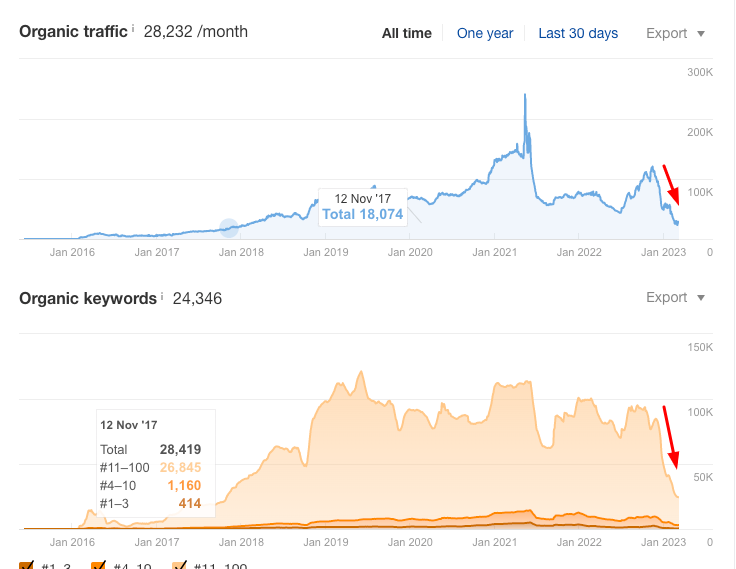
Worse still are the sites that get thousands of unique, qualified visitors per day. They truly have the most to lose in a search engine optimization campaign. These SEO campaigns support real revenue, and bad SEO here can be costly.
But they are, the harder they fall:
Pursuing a bad strategy
A very bad SEO practice—such as large-scale keyword stuffing, manipulative link building, or ignoring technical web development fundamentals—here can cause some serious damage, such as dramatic drops in Google ranking. At this level, a Google penalty from an egregious error could result in devastating losses of visibility and traffic—so avoid any black hat practices like the plague! Smaller errors can have a significant effect as well, but by this point your domain authority is so well established that it won’t take much time or effort to fully recover. While established authority helps recovery, penalties still hurt visibility and trust with search engines.
Failing to invest enough time or money
At this level, if you want to see more results, you’ll have to invest a large chunk of time and/or money.
Otherwise, your efforts will merely keep you afloat. Staying afloat can still yield a positive ROI, but be careful not to let your efforts slip, or your ranks could start steadily dropping.
High-authority sites must continuously optimize title tags, refresh meta descriptions, and align content with user intent. Without ongoing investment, rankings decline gradually as competitors improve their effective SEO campaign strategies.
Even companies with ample traffic may not have large enough budgets to chase the rankings of short-tail keywords of competitors.

Even with a large link building budget, it will still likely take years to achieve 5K+ referring domains to your website.
Paying too much
It’s still possible to spend too much for cost of SEO services, especially if you’re already enjoying a nice search position.
Choose your partners and SEO consultants carefully.
Conclusion
As you can see, there are real risks associated with both national and local SEO campaigns—but only when bad SEO practices are involved. Going with the cheapest option, ignoring user intent, relying on keyword stuffing, or chasing shortcuts represents the worst SEO path possible, as is flying blind and hoping for the best when you don’t know what you’re doing. But even in those cases, there’s no such thing as irreversible damage. Unless you’re deliberately pursuing spam-based or other terrible onsite strategies, it’s almost impossible to be blacklisted by Google (and even if you are, you can always appeal). Google penalties can be reversed, rankings can recover, and trust with search engine crawlers can be rebuilt.
Realistically, as long as you’re working with qualified SEO agencies (either through an authoritative SEO agency or an in-house expert) and prioritizing quality content, ethical link building, and sound content strategy, an effective SEO campaign, you should have no problem achieving a positive ROI your SEO campaign and growing organic traffic and long-term visibility across all major search engines.