
What is Programmatic Advertising & How Does it Help SEO?
 Timothy Carter
Programmatic advertising involves the automated purchase and sale of advertising space, eliminating the need for manual interactions. If you’ve seen Facebook ads, that’s an example of programmatic ads.
While running ads on search engines and social media sites is easy, placing an ad on most digital platforms still requires you to follow the traditional protocol, which requires time and negotiation.
Programmatic advertising streamlines the digital advertising process, making way for a more efficient model and weeds out the need to negotiate advertising specifics manually.
This concept has changed the digital advertising dynamics, and it is only poised to grow more in the future. However, as of now, this process is only applicable to digital advertising, so companies might find it hard to incorporate it within their traditional marketing mix, or they might need to supplement it with other channels.
But what does the future look like?
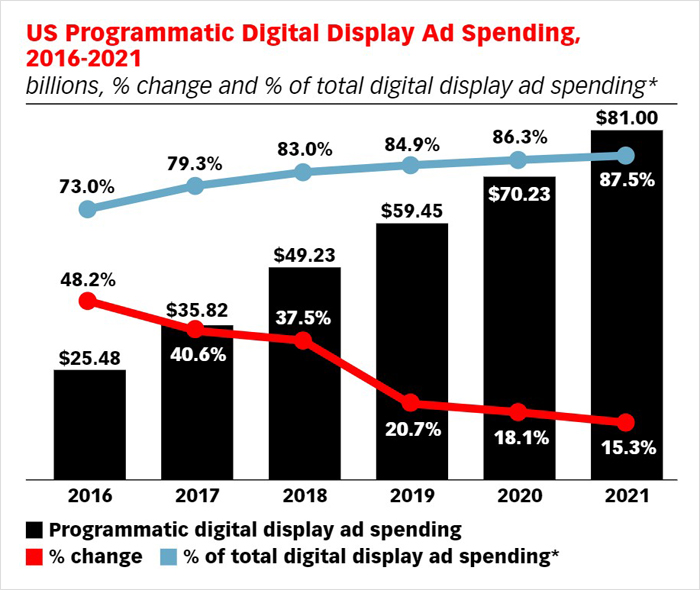
For starters, it is predicted that 88% of all U.S. display ad spending will go to programmatic ads by 2021. In fact, the global programmatic ad spends crossed $129 billion, and the numbers are set to surpass $150 billion by 2021.
Of course, these numbers are impossible to ignore because they show that most businesses in your niche are already experimenting with programmatic ads or will be doing so shortly.
That’s why in this blog, we’ll discuss how you can make it work for you and top trends in programmatic ads that you should try out in 2021.
How Does Programmatic Advertising Work?
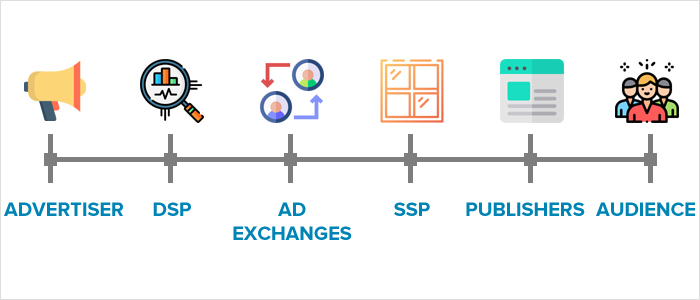
The central backbone to this protocol is the ad exchange, which functions similarly to the traditional model, where marketers and advertisers negotiate with website owners for advertising price.
This involves website owners connecting to an ad exchange through a supply-side platform (SSP), which allows them to broadcast the available advertising space. A Demand-Side Platform (DSP) works in the same way, but on the part of the advertisers, notifying them about advertising options that may fit their criteria.
To get the most value from their ads, advertisers should also use a data management platform that allows them to collect information about their advertising campaigns and automate decision-making. While DMPs aren’t a part of the traditional programmatic advertising ecosystem, they’re still a crucial tool to make your advertising effective.
What Is The Cost Of Programmatic Advertising?
CPM, or the cost per thousand impressions, determines the cost for programmatic advertising. This metric varies by price on the target audience, budget, ad run time, and supply settings.
For programmatic advertising, advertisers are charged through real-time bidding.
How Do I Measure Programmatic Advertising?
Clicks, actions, and impressions are the three most important ways to determine the efficacy of a programmatic advertising campaign. In addition, advertisers can use other key performance indicators that relate to their business objectives, such as sales, subscriptions, cost per acquisition, and return on ad spends.
Avenues For Programmatic Advertising
Here are some of the most commonly used channels for programmatic advertising:
Display Ads
While most people assume display ads to mean any visual ads, they’re used in a specific context in programmatic advertising. Display ads denote ads that are positioned only at headers, footers, and sidebars.
Advertisers must deal with platforms like Google to facilitate the sale and purchase of ad slots. The ads generate revenue on the number of clicks and impressions that the hosting network collects.
Audio Ads
Audio ads are quite slept on, and most people would assume them to be a product of the radio era. But thanks to the growing podcast industry, audio ads are relevant more than ever in the online sphere.
While podcasts generally use conventional sponsorship campaigns for advertisement purposes, programmatic advertising can amplify and streamline revenue generation for businesses through more targeted campaigns.
Programmatic audio advertising relies on real-time data from audiences for ad placement and uses audio ads combined with display and video ads for a more optimized advertising experience.
Streaming sites often feature audio ads as companion ads to video ads, while ad pods are equivalent to video ads. The most popular platforms advertisers use for audio ads include SoundCloud, Pandora, and Google.
Video Ads

Video content has become the most popular mediums online, thanks to the rise of video streaming platforms like YouTube and TikTok, with popular social media platforms like Instagram and Facebook rapidly capitalizing on the video content market with IGTV and Facebook Live.
As such, the growing demand for video content makes digital video ads a particularly lucrative option for advertisers. There are three main categories of video ads that advertisers can tap into:
- In-stream ads
- Out-stream ads
- In-display ads
In-stream ads appear in the video player, such as before a video (pre-roll), between a video (mid-roll), and after a video (post-roll). Out-stream ads show up during online articles, either as pop-up windows or as a part of the main content. In-display ads are displayed as video recommendations or show up during video search results.
Social Media Ads
Social media platforms are a great avenue for digital advertising. These platforms collect extensive user data, which enhances their audience targeting features. Programmatic advertising campaigns use this data to sieve through the demographics they want to target, the best time for running the ads, the frequency of the ads, and other important metrics.
Social media ads aren’t just limited to social media platforms. With programmatic advertising, advertisers can use data to identify influencers and popular personalities on social media platforms to advertise on their behalf.
Digital Out-of-Home Advertising
Digital out-of-home advertising (DOOH) is the equivalent of conventional out-of-home for digital media. Traditionally, advertisers would contact networks and negotiate the pricing, target audience, frequency, and timings. Digital DOOH follows the same protocol and allows advertisers to use technologies like GPS and RFID to enhance their campaigns.
How Does Programmatic Advertising Help With SEO
Besides reducing the margin for human error and automating the advertisement process, programmatic advertising can also help improve your marketing and SEO strategies, such as:
Real-time Data
Conventional advertisements don’t allow advertisers to determine the effectiveness and accuracy of their campaigns.
But with programmatic, advertisers can get real-time information about their advertisement campaigns. They can use this data to learn more about their target audience and tweak their ads accordingly.
Improved Audience Targeting
Programmatic advertising allows marketers to adopt multiple approaches to connect with their target audiences. The process involves combining first and third-party data to make the audience profile more accurate.
The other approach involves contextual advertising that derives data from user-profiles and page content to improve the relevancy of ads. In addition, advertisers can adopt other techniques like geo-targeting, IP address targeting, and app targeting to refine and personalize their ads better.
Greater Transparency
With programmatic advertising, advertisers can know how their budget is utilized, how well their ads are doing, how much their ad inventory is, and which audiences their ads target.
The high transparency makes it easier to gauge and improve efficiency, and the lack of human interferences greatly reduces the possibility of error.
Also, programmatic advertising allows advertisers to allocate their budget effectively, using real-time campaign data, to ascertain which avenues will yield the best results and give the best ROI for their SEO campaigns.
Also, the digital advertising space is replete with unethical practices and fraudulent tactics. On the other hand, programmatic advertising offers high transparency, allowing advertisers to gauge each campaign in real-time and avoid platforms that don’t deliver.
Types of Programmatic Media Deals
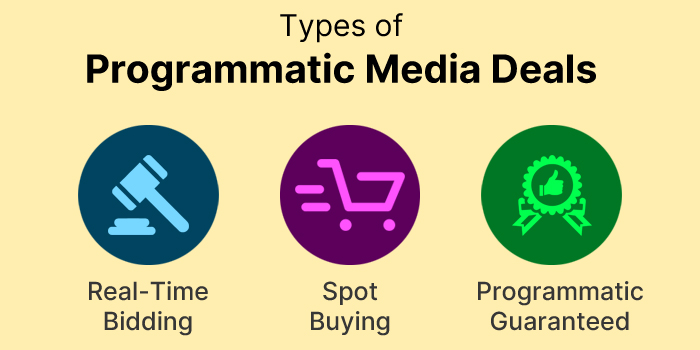
Unlike conventional advertisement dealings, advertisers do not always have to work on a one-to-one basis with publishers to buy ads. Instead, the ad delivery will depend on the deal chosen for programmatic advertising, which determines the criteria for ad delivery on websites. Here are some of the programmatic advertising deals for buying and selling ads:
Real-Time Bidding
Real-time bidding, also known as open auction, is the most preferred method of programmatic ad buying by advertisers and markets. The ad slots are open for everyone to bid and sold via bidding. The bidding process takes place in real-time, and advertisers can bid for all available slots.
The bidder does not have to pay the bidding amount to get the slot; instead, they have to rely on the second-price auction formula only to pay $0.01 more than the amount bid by the second-highest bidder. Thus, consecutively, the second-highest bidder is charged just slightly over the third-highest bidder’s bidding price and so on.
Although this technique is simple, it does not have much transparency since the advertisers don’t know the exact publisher websites where their advertisements will be displayed.
Spot Buying
Advertisers can book ad inventories for fixed prices with spot buying before making them public for open auctioning. This involves a negotiation process involving both parties with regards to pricing and other important metrics. Advertisers can use DSPs to understand the audience and then move forward to purchase an ad.
Programmatic Guaranteed
Programmatic guaranteed buying follows the same protocol that is common for traditional ad space and media buying. In this scenario, the publisher and advertiser will reach an agreement after a negotiation process. The negotiation will be one-on-one, without a bidding process or any other third parties involved. After the negotiation, the publisher will sell the ad inventory to the advertiser directly.
Programmatic lets advertisers choose their prices, target audience, ad inventories on their own. This technique is used by advertisers who know exactly where they want to place their ads and have a large advertising budget.
Key Platforms in the Programmatic Advertising Ecosystem
Programmatic advertising platforms rely on a network of interconnected technologies that automate how advertisers buy ad space and how publishers sell ad space. Understanding how these systems work together is critical to executing effective programmatic ad buying strategies.
At the center of this ecosystem is the demand side platform (DSP). A DSP allows advertisers to buy ad space across multiple ad exchanges from a single interface. Through a DSP, advertisers access ad exchanges in real time, evaluating available advertising inventory and bidding based on audience data, budget constraints, and campaign goals. This process enables highly efficient programmatic ad buying at scale.
On the other side are supply side platforms (SSPs), which publishers use to sell ad space. SSPs connect publishers to multiple ad exchanges, allowing them to maximize revenue by exposing their digital ad inventory to a wide pool of advertisers. The use of multiple ad exchanges ensures competition for impressions, helping publishers optimize yield.
Ad exchanges act as the marketplace where these transactions occur. They facilitate real-time bidding between buyers and sellers of online advertising. In contrast, ad networks aggregate inventory from multiple publishers and package it for sale, often with less transparency than exchanges.
Another critical component is data management platforms (DMPs)
—sometimes referred to as data management platforms DMPs—which collect, organize, and activate audience data. These platforms allow advertisers to refine targeting and improve performance across programmatic advertising platforms.
Together, DSPs, SSPs, ad networks, and ad exchanges create a system where advertisers can efficiently buy ad space while publishers can scale how they sell ad space across a global marketplace of digital advertising opportunities.
How to Plan and Optimize a Programmatic Ad Campaign
Running successful programmatic campaigns requires more than just automation—it demands a structured approach to strategy, execution, and optimization.
The first step in any programmatic advertising campaign is defining clear objectives. Whether the goal is brand awareness, lead generation, or conversions, those objectives will guide your ad buying process and influence how budget and creative are deployed.
Next, advertisers must identify their audience segments using first-party and third-party data. This data feeds into DSPs and DMPs to ensure ads are delivered to the most relevant users. From there, advertisers set budgets, manage ad spend, and determine bidding strategies within their programmatic ad campaign.
Creative testing is another key component. High-performing ad campaigns often rely on multiple variations of messaging, formats, and placements. Tracking ad impressions, click-through rates, and conversion metrics helps refine performance over time.
Optimization is ongoing. Advertisers adjust bids, pause underperforming placements, and shift budget toward higher-performing inventory. This continuous feedback loop is what makes programmatic marketing more dynamic than traditional methods.
Ultimately, the strength of programmatic campaigns lies in their ability to combine automation with real-time data. When executed correctly, they can significantly improve overall marketing efforts while reducing inefficiencies in the ad buying process.
Benefits, Costs, and Best Use Cases for Programmatic Advertising
Programmatic advertising offers several advantages over traditional advertising methods, particularly in terms of efficiency, scalability, and targeting precision.
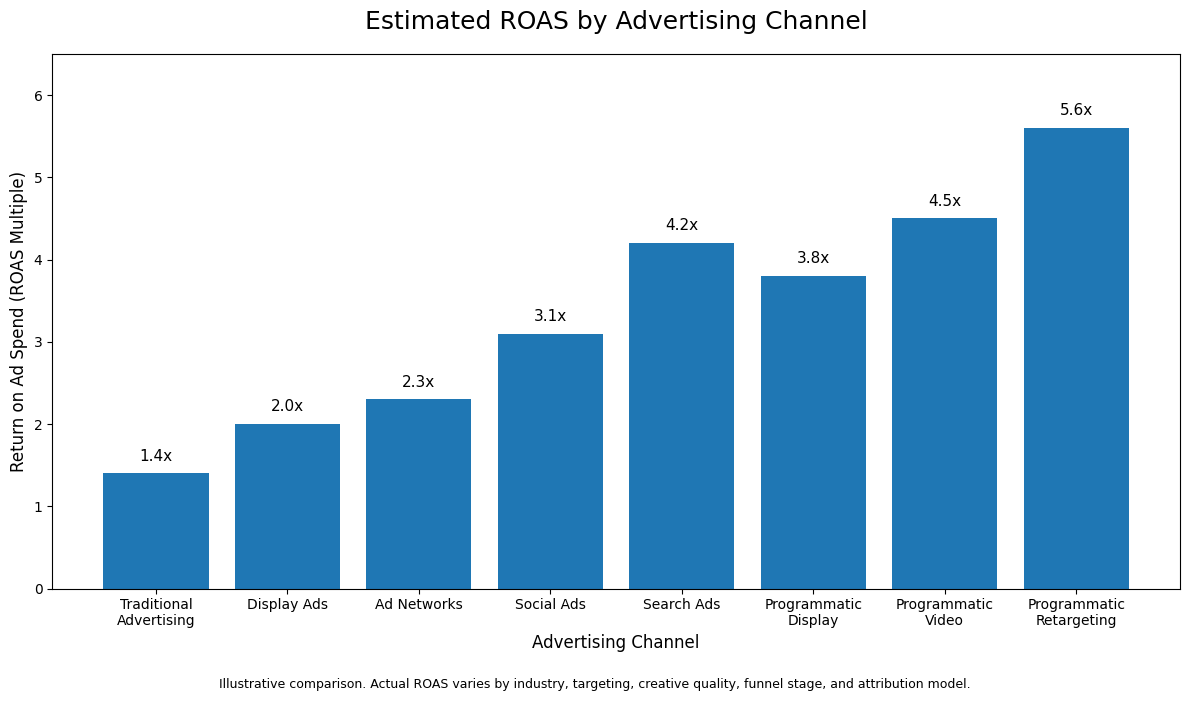
Relative ROAS by Advertising Channel
One of the primary benefits of programmatic advertising is marketing automation.
Instead of negotiating placements manually, advertisers can deploy programmatic ads across a wide range of online ads inventory in real-time. This real-time delivery allows brands to scale their online advertising efforts quickly while maintaining control over targeting and budget.
Another key benefit is improved targeting (e.g. geographic, psychographic etc.). Programmatic marketing uses data to ensure ads are shown to the right audience at the right time, increasing relevance and reducing wasted ad spend. Compared to traditional advertising, this level of precision leads to better performance and higher return on investment (ROI).
However, understanding programmatic advertising cost is essential. Costs can vary depending on competition, audience targeting, and ad formats. Most programmatic ads are priced on a CPM (cost per thousand impressions) basis, though CPA and CPC models are also common. Higher-quality ad space and premium inventory will command higher prices, especially in competitive industries.
Programmatic advertising is particularly effective for campaigns that require massive scale, such as brand awareness initiatives, retargeting efforts, and multi-channel digital advertising strategies. It also works well for businesses looking to expand beyond search and social into broader online advertising ecosystems.
That said, programmatic isn’t always the right fit. Smaller campaigns with limited budgets or highly niche audiences may perform better with more controlled, manual placements.
In most cases, though, the combination of automation, targeting, and scalability makes programmatic advertising one of the most powerful tools available in modern digital advertising.
In Conclusion
Programmatic advertising lets you run high-impact ads that are beautiful to look at and designed to captivate the audience. However, to get the most from these creatives, make sure that you use the correct ad format for the environment.
Brands have some unprecedented opportunities to employ the amazing programmatic trends detailed above. The market isn’t too saturated just yet, so you can use this time carefully to find your footing as a programmatic advertising pro.